
Android Barcode Scanner SDK
Barcode scanning, rebuilt for AI and Agent Skills. Accuracy where other SDKs give up, and accidental scans eliminated. All integrated autonomously into your Android View or Jetpack Compose hierarchy.





We know how to get barcode scanning working on any Android device for any scenario
80bn
scans processed in 2025
170m+
active mobile devices
20k+
device models supported
480 barcodes a minute is just the start
Scan speeds <200ms per scan feel instant to human perception — what matters more is preventing bad data entering your system. Scanning at scale requires accuracy close to 100%.
:format(webp))
Accuracy where other Android barcode scanners give up
- Consistent accuracy rate >99% for most barcodes and real-world conditions.
- Long-range scanning: in a calibrated test environment, the Scandit SDK read common retail barcodes (EAN-13, EAN-8, UPC-E and Code 128) from an average distance of 77 cm.
- Reliable capture of torn labels, tiny barcodes, curved and shiny surfaces, codes at long ranges, low light, extreme angles, motion blur.
- If a barcode is too damaged to scan, the Scandit barcode scanner SDK automatically reads the printed digits below using OCR instead.
:format(webp))
No more accidental scans with AI-powered contextual awareness
- Capture the right barcode, even when aiming is imperfect.
- Aimer overlay automatically triggered when barcodes are too close to each other.
- Reduce duplicates using behavior analysis rather than fixed timeouts to distinguish intentional from accidental scans.
Pre-built components that turn scanning into guided workflows
Capture every barcode in view with just one press. Help users pick, count, and flag with AR overlays on their screens.
MatrixScan Count
Pre-built scan and count component for receiving goods, cycle counting, inventory, and tote mapping. Includes customizable AR overlays, button counter badge, and progress bar.
MatrixScan Find
Pre-built component to find one item among many for ISOF, order assembly, pickup at PUDO, or finding a delivery. Native UI includes customizable AR overlays, pause button, item carousel, and notification alerts.
MatrixScan Batch
Multiple barcode scanning that’s lightweight, fully customizable, and doesn’t require AR. Batch process barcodes and handle multi-code labels with unparalleled speed and accuracy.
MatrixScan AR
Capture multiple barcodes with the help of AR status icons, pop-overs, and information overlays. Customize color, text, font, size, overlay placement, and behavior.
< 1 hour median time to first scan
Build from scratch or skip the edge cases with Native Android Agent Skills and pre-built components.
-
# Install with one command:
npx plugins add scandit/skills

# Claude Code:
## 1.
/plugin marketplace add scandit/skills
## 2.
/plugin install scandit-sdk@scandit-plugins

# Codex CLI:
## 1.
codex plugin marketplace add scandit/skills
## 2.
codex plugin add scandit-sdk@scandit-plugins
Scandit Agent Skills
Teach your Android coding agent 15 years of barcode scanning expertise: Claude Code, Codex, Cursor, GitHub Copilot, Gemini, OpenCode, and 40+ others.
- A single line of copy-paste code installs the Scandit Agent Skills bundle for Android.
- Run one prompt that describes your use case in plain language.
- Scandit Agent Skills handles Gradle/Maven, license activation, View or Jetpack Compose, performance tuning, and edge cases.
- Get automatic updates with every release, so the generated code always targets current, validated Scandit APIs.
-

More than just docs
Get demo apps, realistic code samples, detailed documentation, UX best practice library and guidance, QA guides and assets.
-

Security by design
All image processing performed on-device by default. Customers retain complete control over data collection and processing. ISO27001 certified.
-

>98% support NPS score
Access to industry-leading scanning experts for everyone, plus dedicated customer success resource for eligible customers.
From start-ups to global giants
:format(webp))

There were many models of Android-compatible smartphones with different OS versions, and the open source library we were using for development was becoming complicated. Among the software we compared, Scandit was the best. Furthermore, it achieved stable reading even with different Android models.
Yuji Konno, Consumer Data Management Department, Data Management Division | 3,300-person marketing research company
:format(webp))

With Scandit, we enabled associates to scan a large area of shelves and easily identify incorrect prices. We also built a capability to allow one-touch tag printing to update prices in real time.
Lance Martel, CIO | 11,000-person office retail chain
:format(webp))

Two issues were important to us... guaranteeing high performance across multiple types of barcode ... [and] how well the product would be supported. Scandit outperformed alternative open-source and plug-in solutions on both fronts.
Stefan Graf, Product Owner | 37,000-person national railway
:format(webp))

Don't underestimate how much the quality of your scanning technology shapes everything downstream.
Yixin Zhu, VP of Engineering | 200-person consumer grocery start-up
Broad framework and device support
 iOS
iOS  Android
  JavaScript
  React Native
  Cordova
  Kotlin Multiplatform
  Flutter
  .NET
.NET  Capacitor
  Titanium
  Linux
Linux Scandit supports all major frameworks and 20,000+ models of smart devices, including smartphones, tablets, handheld computers, and wearables.
The Android Barcode Scanner SDK supports all major barcode types

ArUco

Aztec Code

Codabar

Code 11

Code 128
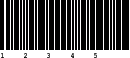
Code 25

CODE 32 Italian Pharmacode

Code 39

Code 93

Data Matrix

DotCode

EAN Code

GS1 Composite Codes

GS1 Databar

IATA 2 of 5

Interleaved 2 of 5 (ITF)

KIX

Matrix 2 of 5

Maxicode

Micro QR Code

MICROPDF417

MSI Plessey

PDF417 Barcode

Posi LAPA 4 State Code

QR Code

Rectangular Micro QR Code

RM4SCC

UPC Code

UPU S18 4-State
