
Barcode Symbologies
A barcode symbology is the name
for a type of barcode
Most people are familiar with the UPC or EAN barcodes found on product packaging, and QR codes. However, there are over 30 different barcode symbologies with different opportunities and limitations.
One-dimensional (or 1D) barcodes encode data by changing the widths and spacings of parallel lines. Two-dimensional (or 2D) barcodes represent data on both the horizontal and vertical axes. They can represent more data per unit area. It’s important to choose the right barcode for your use case.

ArUco
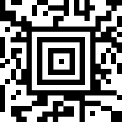
アステカコード

コーダバー

コード11

コード128

コード25

CODE 32 イタリアンファーマコード

コード39

コード93

Data Matrix

ドットコード

EANコード

GS1コンポジットコード

GS1データバー

IATA 2の5

インターリーブド2オブ5(ITF)

KIX

行列 2 の 5

マキシコード

MICROPDF417

Micro QRコード

MSI Plessey

PDF417 バーコード

ポジLAPA 4ステートコード

QRコード

長方形マイクロQRコード

RM4SCC

UPCコード

UPU(万国郵便連合)S18 4-State

USPSインテリジェントメール
No symbologies found for the selected category.
Frequently asked questions
Contact usThe most common barcode types are:
- UPC barcodes, used to label and scan consumer goods at points of sale around the world – mainly in the United States.
- EAN barcodes, also used to label consumer goods worldwide for point-of-sale scanning, primarily in Europe.
- Code 39 barcodes (also known as Code 3 of 9) are used to label goods across many industries and are often found in the automotive industry and the U.S. Department of Defense.
- Code 128 barcodes are compact, high-density codes used in logistics and transportation industries for ordering and distribution.
- ITF (or Interleaved 2 of 5) barcodes are used to label packaging materials across the globe.
- Code 93 barcodes are used in logistics to identify packages in retail inventory, label electronic components, and provide additional delivery information.
- Codabar barcodes are used by logistics and healthcare professionals, including U.S. blood banks, FedEx, photo labs and libraries.
- GS1 DataBar barcodes (formerly known as Reduced Space Symbology) are used by retail outlets to identify consumer coupons, produce and perishables, as well as small objects in the healthcare industry.
- MSI Plessey (or Modified Plessey) barcodes are used for inventory management in retail environments, such as labeling supermarket shelves. They’re also used across warehouses and other storage facilities to support accurate inventory checking.
- QR codes are most often used in tracking and marketing initiatives, such as advertisements, magazines and business cards.
- Data Matrix codes are usually used to label small items, goods and documents. Their tiny footprint makes them ideal for small products in logistics and operations.
- PDF417 codes are used for applications that require the storage of huge amounts of data, such as photographs, fingerprints and signatures.
- Aztec codes are commonly used by the transportation industry, particularly for tickets and airline boarding passes.
You can find a visual identifier of the 13 most common barcodes in our Types of Barcodes: Choosing the Right Barcode guide.
There are hundreds of barcodes (also called symbologies), but only about 30 in common use.
One-dimensional (or 1D) barcodes represent data by varying the widths and spacings of parallel lines. These include some of the most traditional and well-recognized barcode types, such as the UPC and EAN codes used to identify products.
Two-dimensional, (or 2D) barcodes encode data on both the horizontal and vertical axes. They are similar to a linear 1D barcode, but can represent more data per unit area. 2D barcodes include newer barcode types, such as QR codes and PDF417.
What the most common barcode symbol is depends on your context. The UPC and EAN codes used to identify products, together with QR codes, are best known to consumers. Retailers also use barcodes such as GS1 DataBar or MSI Plessey in back-of-house operations.
Code 39 barcodes are often found in the automotive industry and the U.S. Department of Defense. In logistics you’re more likely to come across Code 128, Code 93, Codabar, Data Matrix or ITF barcodes. PDF417 codes are often found on IDs (including U.S. drivers’ licenses), and Aztec codes are commonly used for tickets and airline boarding passes.
Learn more in our Types of Barcodes: Choosing the Right Barcode guide.
Barcode data is data that has been encoded in a barcode, either by varying the widths and spacings of parallel lines (known as 1D barcodes or by encoding data on both the horizontal and vertical axes (known as 2D barcodes). UPC or EAN barcodes are exaWhat is barcode symbology?mples of 1D barcodes, while QR codes are an example of 2D barcodes.
Barcode data can be extracted by barcode scanning software running on any smart device. The data is then used by other applications – for example, to direct you to a website or record a delivery. Advanced smart data capture applications add features such as AR overlays that provide real-time insights on things such as stock levels or nutritional information.
Barcode symbology is simply the name for a type of barcode. The majority of people are aware of QR codes and UPC or EAN barcodes, which are present on product packaging. However, there are more than thirty distinct barcode symbologies, each with unique advantages and disadvantages.